
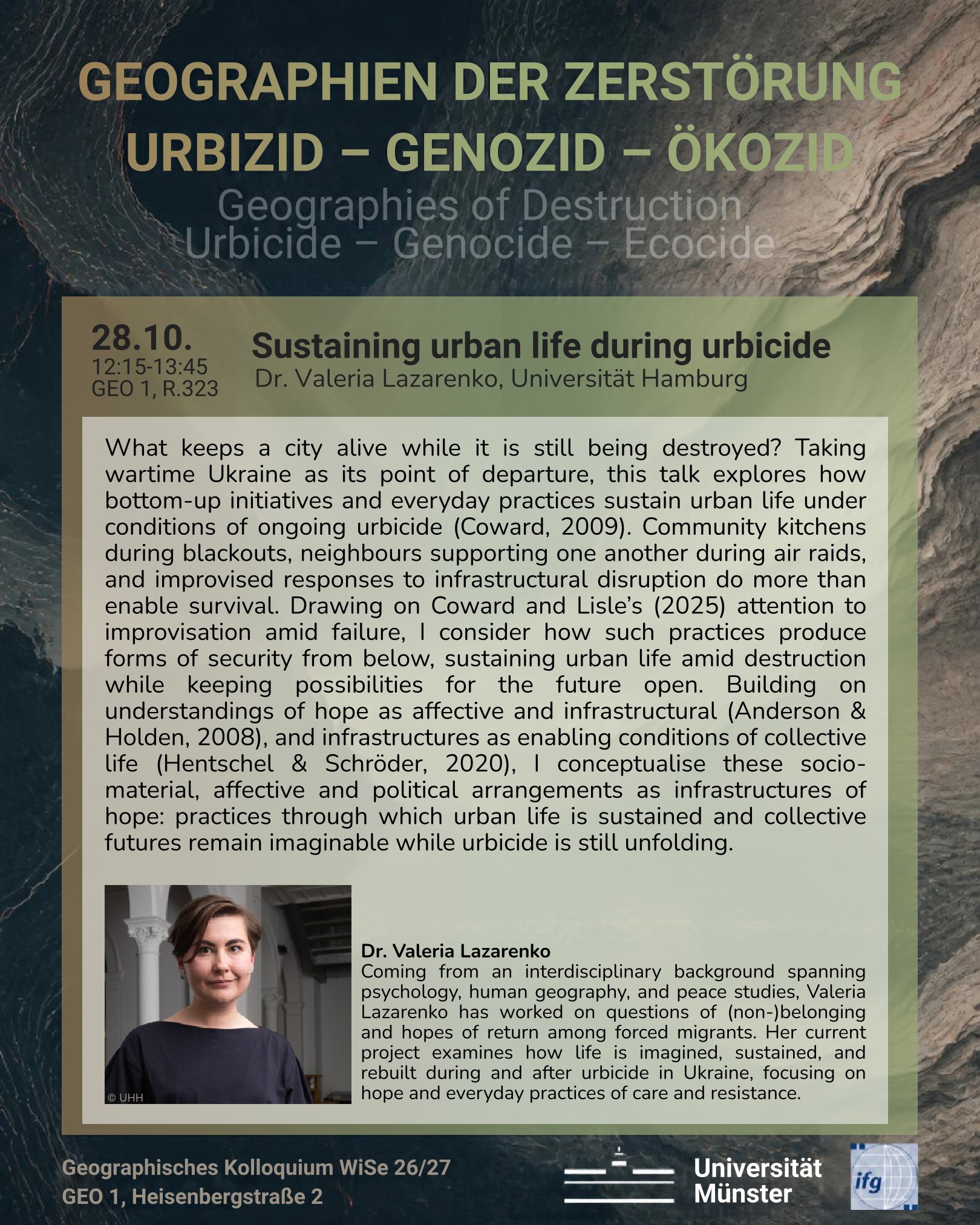
Der Vortrag von Dr. Valeria Lazarenko (Universität Hamburg) findet statt im Rahmen des Geographischen Kolloquiums "Geographien der Zerstörung: Urbizid - Genozid - Ökozid". Die Vortragenden werden u.a. die Frage diskutieren, wie und warum sie sich in unterschiedlichen Themengebieten und Kontexten auf die normativ-rechtlich geprägte "-zid"-Begrifflichkeit beziehen.
What keeps a city alive while it is still being destroyed? Taking wartime Ukraine as its point of departure, this talk explores how bottom-up initiatives and everyday practices sustain urban life under conditions of ongoing urbicide (Coward, 2009). Community kitchens during blackouts, neighbours supporting one another during air raids, and improvised responses to infrastructural disruption do more than enable survival. Drawing on Coward and Lisle’s (2025) attention to improvisation amid failure, I consider how such practices produce forms of security from below, sustaining urban life amid destruction while keeping possibilities for the future open. Building on understandings of hope as affective and infrastructural (Anderson & Holden, 2008), and infrastructures as enabling conditions of collective life (Hentschel & Schröder, 2020), I conceptualise these socio material, affective and political arrangements as infrastructures of hope: practices through which urban life is sustained and collective futures remain imaginable while urbicide is still unfolding.
