
Münster is not an innocent backdrop. And this August, we are claiming space in it.

The Un•colonial Film Festival — five days of BiPoC-led cinema, workshops, dialogues, and performances — takes place here from 24 to 28 August 2026. We are building it without state funding, without corporate money, and without asking permission. We are building it because the evidence of why it needs to exist is all around us. Including inside the building where we study.
THE BUILDING
Three in four immigrants or their descendants experience discrimination in Germany. One in three people in Germany still believes in biological human races, a concept disproven in the middle of the last century. One in four Black people living in Germany say they get insulted, threatened, or attacked at least once a month. Nearly one in five Muslims in Germany has had the same experience. People who experience discrimination carry 25 percent less trust in the police and nearly 20 percent less trust in government. These are not statistics from a distant study. They are the daily architecture of life for BiPoC students in this country, in this city, in this university.
The political climate in which we organise is not separate from this. Germany recorded a record 84,172 politically motivated crimes in 2024, almost half of them motivated by far-right ideology — one far-right crime every 12 minutes. Here in North Rhine-Westphalia, the state where Münster sits, hate crime rose by 43 percent in 2024. And the fastest growing group of suspects is not adults. It is children between 14 and 17 years old, whose numbers tripled in a single year. This is the country our festival is being built in.
This is not an isolated incident. It is a precise example of what the head of Germany’s National Racism Monitor, Cihan Sinanoglu, told Deutsche Welle: racism in Germany is becoming more subtle and adapting to social norms, operating through polite phrases, assumed language hierarchies, and the constant policing of who belongs and who does not. The university reproduces this every time it treats such incidents as individual, apolitical mistakes.
This is also the city where the BiPoC Referat’s own representative, returning home after an event on the night of 15 November 2025, was deliberately confronted by a white German man who pushed their bicycle, hurled hostile words, and raised his fist to strike their face. When our representative acted to stop the attacker from fleeing, the police who arrived treated our representative as the problem. While they were bleeding and unable to move their finger, officers prioritised the attacker, demanded identification from the person who had called for help, and issued a restriction order against our representative. X-rays later confirmed a fracture. Doctors predicted a recovery of six to eight weeks. Months later, it has not fully healed. This is how racial violence and institutional bias operate side by side. Not as exceptions. As a system.
These incidents do not emerge from nowhere. Münster’s colonial entanglements remain largely unexamined while its institutions continue to reproduce the same hierarchies in new forms. This is the city where BiPoC students navigate racism in lecture halls, in funding decisions, in the silencing of our voices within the very structures that claim to represent us.
We are building this festival in this city. Not somewhere else. Not in more comfortable language.
THE UN•COLONIAL FILM FESTIVAL
Five days. Four thematic blocks. Films, dialogues, workshops, performances. In person and hybrid.
- Land, Extraction, Memory: how territory is stolen, poisoned, contested, and how communities resist and reclaim their connection to place.
- Diaspora, Exile, Refusal: living between worlds, in grief, anger, ambivalence, and survival — and the acts of resistance that displacement does not extinguish.
- Form as Weapon: experimental, essay, and hybrid works that use form itself as an act of resistance — aesthetics the mainstream circuit would never fund or canonìse.
- Futures / Otherwise: resistance not as a moment but as a continuity. The present and the possible held at the same time. Not optimism. Not closure. A different orientation.
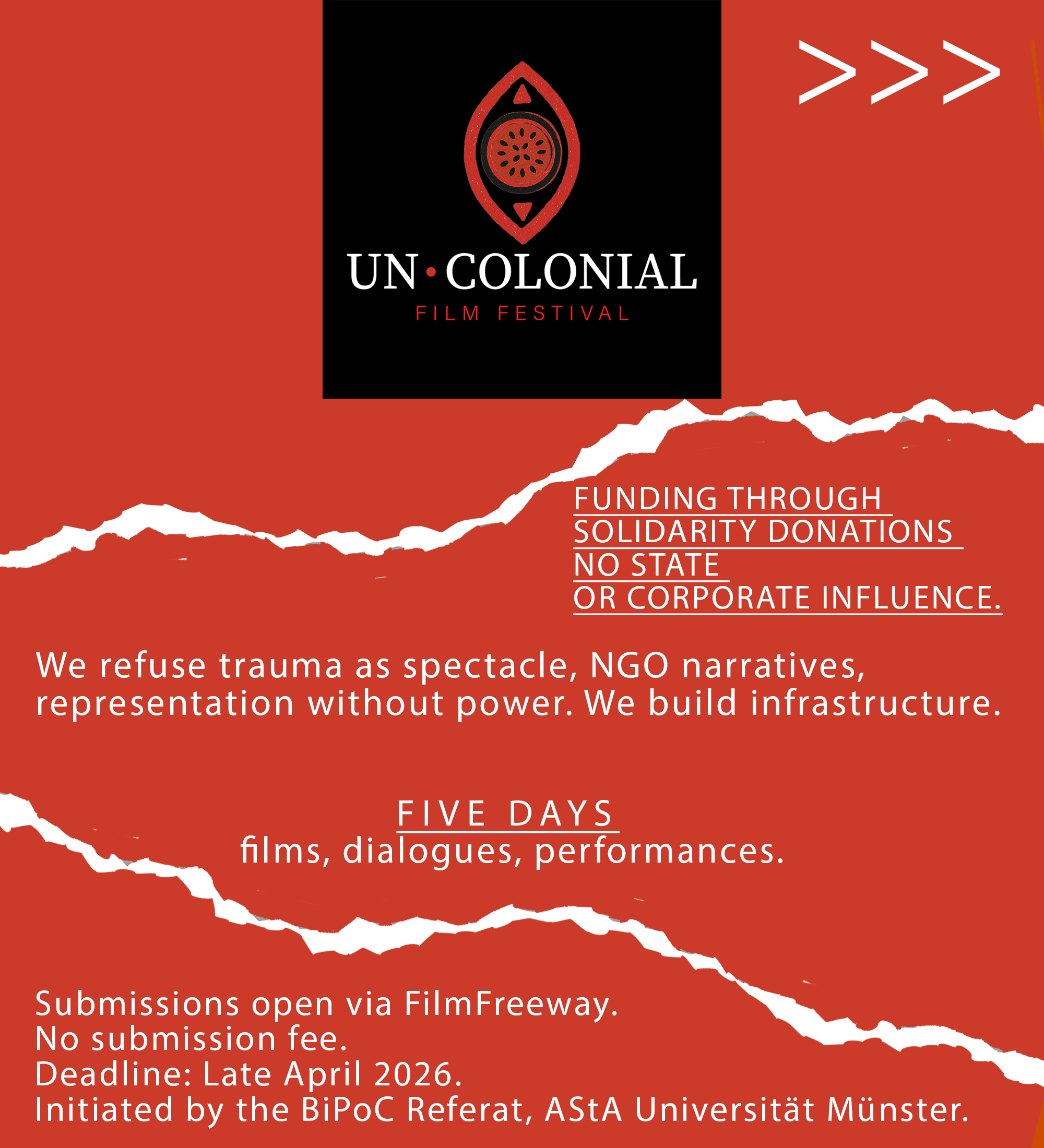
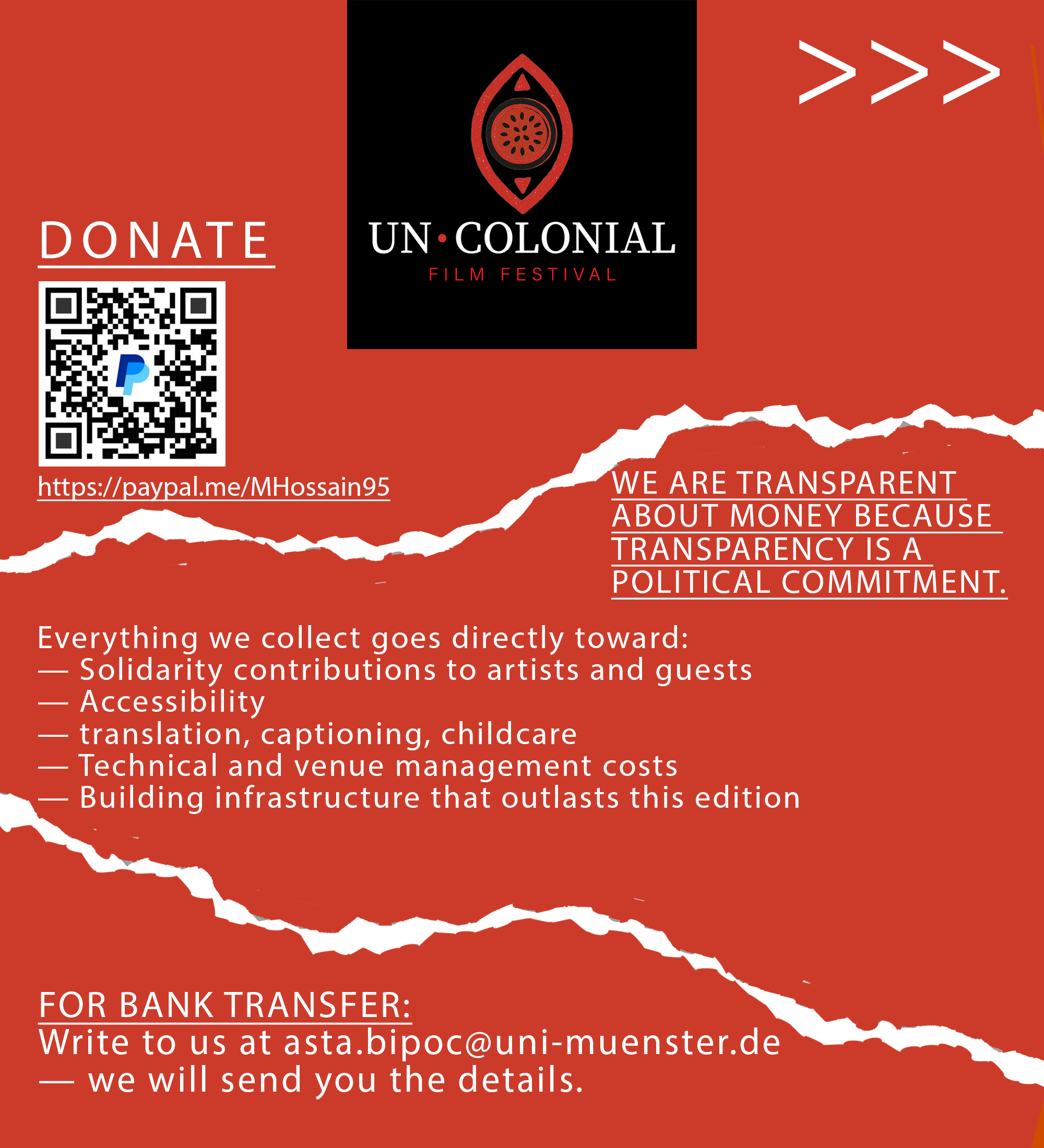
No competitive awards. All selected films are equally valued. The festival is significantly donation-funded. No state money. No corporate support. Not because we could not try, but because we do not want to. Every funding body comes with conditions. We would rather build something smaller and fully ours than something larger and compromised.
WHO IS BUILDING IT
This festival is being built by the Autonomous BiPoC Referat of Universität Münster — collectively, with no institutional budget, no state funding, and no corporate support. We built this because the structures around us were not going to build it for us, and because we could not keep waiting for permission that was never going to come.
The selection committee is collective and non-hierarchical. Its members were chosen not by prestige but by political position and practice — filmmakers and cultural practitioners from across the global majority who have built their own infrastructure, who document what states erase, who carry in their bodies what European solidarity only claims to feel from a distance.
For the programme, we have confirmed a workshop with an Indigenous filmmaker on storytelling as resistance — not as metaphor but as the specific practice through which Indigenous culture has survived colonial violence for generations. A filmmaker whose work confronts occupation and the slow erasure of a people will bring a film that was made because silence was not an option. An artist and researcher working between Europe and Africa will open a dialogue on colonial archives, asking who gets to hold a camera, whose images enter history, and what it costs to return what was taken.
These are not guests. They are the argument.
Full programme — people whose work and lives make the festival’s political commitments legible — announced in June 2026. Festival passes available in the coming weeks.
WHY CINEMA
The colonial gaze still controls cinema. Which stories get funded. Whose aesthetics count as “world cinema.” Who enters the archive. Who gets to be the subject of a film and who gets to hold the camera.
The same logic that told a student in a university building “Das ist Deutschland” also decides whose stories deserve to be told, whose faces belong on screen, and whose films enter the archive. The border regime and the cultural apparatus are not separate systems. They are the same system operating in different rooms. The caretaker and the festival committee that never funds certain stories are both deciding who belongs. One does it with a threat to call the police. The other does it with aesthetic criteria, funding structures, and the slow institutional forgetting of entire cinematic traditions.
Cinema was never neutral. It was there at the checkpoint too, choosing who is seen, who is savage, who is saved. The films we are platforming refuse that position entirely. They do not ask to be included in a system that was built to exclude them. They build their own system. That is what this festival is.
Less than a month after announcing the call for entries, we received over 650 submissions from filmmakers across more than 70 countries.
GET INVOLVED
The submission call is open to BiPoC filmmakers worldwide. Short films up to 30 minutes, completed after 2020. No submission fee. Deadline: late April 2026.
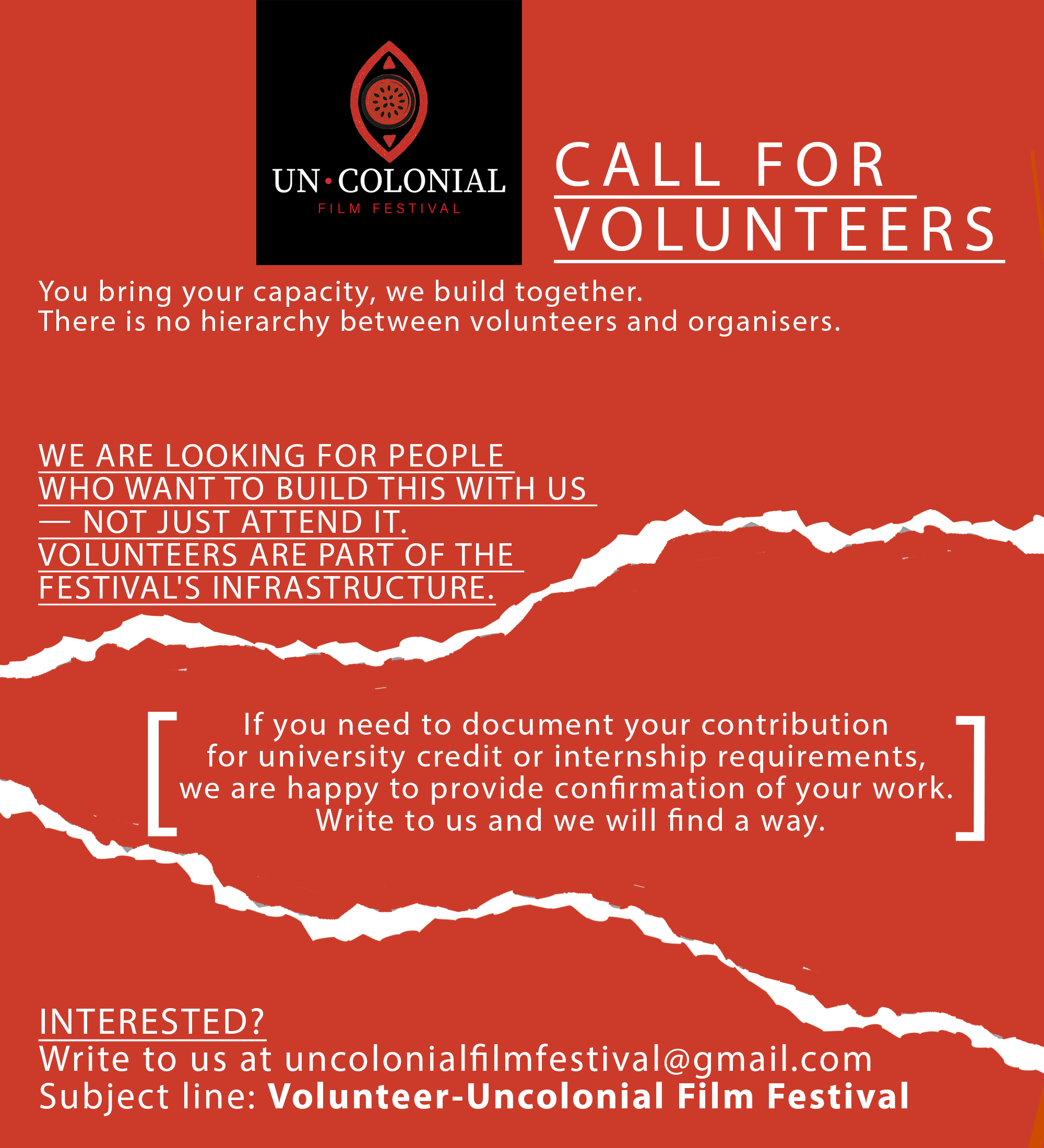
Volunteer with us. We need people for logistics, subtitling, translation, documentation, and social media. Anyone can volunteer, BiPoC people prioritised. If you need to document your contribution for university credit or internship requirements, we are happy to provide confirmation of your work.
Volunteer: uncolonialfilmfestival gmail.com
Donate: paypal.me/MHossain95
Submit entries by the end of April 2026: filmfreeway.com/UncolonialFilmFestival
Website: uncolonialfilmfestival.carrd.co
Instagram: @uncolonialfilmfestival
Sources: National Discrimination and Racism Monitor 2026, DeZIM; Deutsche Welle, March 2026; Federal Government Report on Politically Motivated Crime 2024; NRW Office for the Protection of the Constitution, Situation Report on Right-Wing Extremism 2025.
Space claimed, not borrowed.